The 5P Test: Validate Your Business Idea Before You Invest
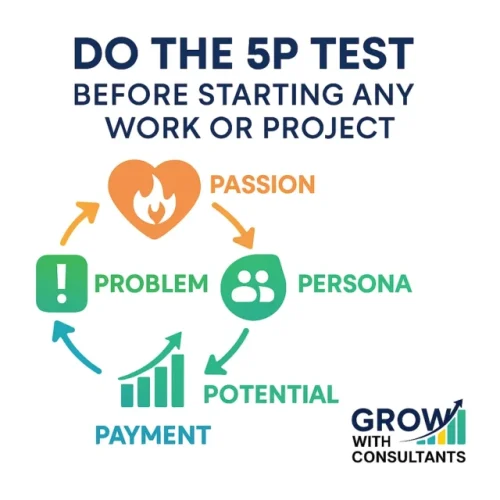
A lot of people say "I want to start a business, but I don't know where to begin." The 5P Test — Passion, Problem, Persona, Potential, and Payment — gives you clarity in under 10 minutes. Most ideas fail because one pillar is weak. This framework helps you spot that risk early, before you spend time or money.
Clarity beats confidence. Once you know the next right step, action becomes easy.
— Ameet Mukherji, Grow With Consultants
What the 5P Test Checks
This is not motivation. It is a reality check across the five pillars that decide whether an idea survives past the excitement phase and becomes a real, revenue-generating business.
The core rule: Score each P out of 5. Target a total of 18 or above with no individual P scoring below 3. A high total score with one weak P is still a risky business. One broken pillar breaks the plan — regardless of how strong the others are.
P1
Pillar 1
Passion — Will You Still Show Up?
Passion is not excitement at the idea stage. Most founders are excited about their idea in month one. Passion is whether you will still work on this problem when results are slow for 6–12 months, when it is boring, when it requires doing things you didn't anticipate.
Most businesses take 12–24 months to become genuinely profitable. Without real passion for the problem you are solving, the majority of founders give up during the difficult early phase — not because the idea was wrong, but because the fuel ran out.
"Would you still work on this if results were slow for 6–12 months?"
Quick test: Could you talk about this problem for an hour to a stranger? Would you find yourself thinking about it on a Sunday morning without being paid to?
P2
Pillar 2
Problem — Is It Real and Painful Enough?
You must be solving a real customer problem — not an interesting one, not a convenient one, but one that causes genuine pain and that people are already trying to solve (even imperfectly). Can you state it in one clear sentence?
The test: when you describe the problem to a potential customer, do they nod and say "Yes, that's exactly me"? Or do they say "Hmm, I suppose that could be an issue"? The first response signals a real problem. The second signals a solution in search of a problem.
"When you describe the problem, do potential customers say 'Yes, that's me' — not 'Yes, that could be a thing'?"
One-line test: Complete this sentence: "I help [specific who] solve [specific what]." If you can't do it clearly in one line, the problem definition needs more work.
P3
Pillar 3
Persona — Do You Know Exactly Who Pays?
"Anyone who needs this" is not a persona. A customer persona is specific: age, role, city, income level, daily habits, frustrations, and budget. The more specific you are, the better your targeting, your messaging, and your lead quality will be.
Businesses that try to sell to everyone succeed with no one. Defining a tight persona feels like leaving money on the table — but it is actually the only way to speak directly to someone's specific situation rather than generically to everyone.
"Could you list 10 real people — by name or specific description — who match this persona and would pay for your solution today?"
Specificity test: Example — "28–35, works as a marketing manager in a 50-person B2B company in Delhi-NCR, earns ₹12–18 lakh, frustrated by having no real data on campaign ROI." That is a persona. "Marketing professionals" is not.
P4
Pillar 4
Potential — Can the Market Support You?
Potential assesses whether the market is large enough, growing fast enough, and open enough for your idea to become a sustainable business. You don't need to capture the whole market — you need to identify a niche within it that can support your revenue goals.
Check: Is demand growing or shrinking? What are competitors doing — and where are they leaving gaps? Are people already spending money to solve this problem (even with inferior solutions)? Money already in motion is the strongest signal that a market exists.
"Is the market growing, and can you carve a profitable niche without needing to dominate the entire space?"
Market signal test: Search Google and check Amazon/Flipkart. If people are already buying imperfect solutions, the market is real. If nothing comes up — either you've found a true gap, or there is no demand.
P5
Pillar 5
Payment — Will Money Come Fast Enough?
Compliments don't keep a business alive. Revenue does. This pillar validates whether people will actually pay for your solution — not just whether they like the idea, follow you on Instagram, or tell you "that's a great concept."
The fastest way to validate Payment: can you sell a small paid pilot in the next 14 days? Not a full product — a minimal, paid version. If you can't get even 2–3 people to pay a small amount quickly, the idea needs more development or a clearer value proposition before any significant investment.
"Can you sell a small paid pilot in the next 14 days — even at a reduced price — to validate that money will actually flow?"
14-day test: Call 10 people who match your persona. Offer a small paid pilot at 50% of your planned price. If 2–3 say yes and pay, your Payment pillar is strong. If 10 people say "sounds interesting, let me know when it's ready" — it is not validated yet.
Example: Applying the 5Ps as a Sports Physio / Gym Trainer
Real-World Application
A gym trainer applying the 5P Test to a sports injury recovery service
Passion
You love fitness and recovery training. You could talk about rehabilitation techniques for hours and find yourself doing research on it on weekends unprompted. Score: 5/5
Problem
Weekend players and college athletes struggle with knee, shoulder, and back injuries that keep them off the field for months. Existing physiotherapists are generic — no one specialises in sport-specific recovery. Score: 4/5
Persona
18–40 years old, play football or cricket 2–3× a week, live within 8–10 km, want to return to sport fast rather than just avoid pain, have a household income of ₹8 lakh+ and will pay for specialist results. Score: 4/5
Potential
Sports participation is rising sharply in Indian cities. Google searches for "sports physiotherapy [city]" are increasing. Competitors exist but are all generic clinics, not sport-specific specialists. Score: 4/5
Payment
Offer a 6-week recovery programme — 1:1 sessions plus a home training plan. Can you sell 3 pilots at ₹4,999 each this month? If you have 10 contacts who play sport regularly and you can close 2–3 in 14 days, Payment is validated. Score: 4/5
✅ Total: 21/25 — strong foundation. If you can close 2–3 paid pilots quickly, you have a niche worth building. Improve the Persona specificity and Problem articulation, then scale with a defined system.
Score Your Business Idea — Interactive 5P Test
Answer honestly. The output is only as accurate as your inputs. Slide each P from 0 (Not at all) to 5 (Absolutely yes). Your score updates in real time and will not be saved.
5P Test — Score Your Business Idea
Score 0–5 on each pillar · Target: 18+/25 with no P below 3
0 = No genuine drive · 5 = Would work on this unpaid for years
0 = No clear problem · 5 = People actively search and spend to fix this
0 = "Anyone who needs it" · 5 = Can name 10 specific people today
0 = No clear market · 5 = Growing market with proven demand
0 = Cannot sell anything yet · 5 = Can close 2–3 paid pilots in 14 days
Your Total Score
Target: 18 or above · No P below 3
0
/ 25
⚠️
🔴 Score 0–10: High Risk — Fix Before Investing
Your idea has significant gaps. This is good news — you found out early, before spending real money. Identify the lowest-scoring P and work on that pillar specifically before proceeding. Do not invest time or money until you can score each P at 3 or above.
🟡 Score 11–17: Viable — But Needs Structure
The foundation is promising but one or two pillars need work. Identify your weakest P, strengthen it, then retest. Consider building a small paid pilot to validate the Payment pillar specifically before committing to a full product or service build.
🟢 Score 18–25: Strong Base — Move to Execution
Your idea has a solid foundation across all five pillars. The next step is building execution systems: SOPs, a defined sales process, team routines, and a lead generation channel. This is where most good ideas stall — not because the 5Ps are wrong, but because the execution systems were never built.
No email. No signup. Just download → fill → score.
Free 30-Min Idea Validation Session
Turn Your 5P Score Into a 180-Day Execution Plan
If your idea passes the 5P Test, the next step is building systems — SOPs, automation, and team routines. WhatsApp Ameet with your score and we'll build a focused plan together.
After the 5P Test — Turning Clarity into Execution
Scoring 18+ on the 5P Test confirms your foundation is strong. But the most common reason good ideas fail is not weak pillars — it is the absence of execution systems after the validation phase.
The S.Y.S.T.E.M. Framework picks up exactly where the 5P Test leaves off: Staff Ownership (team accountability), Your People (hiring right), Standard Operations (SOPs), Tech & Automation (remove manual bottlenecks), Execution & Monitoring (weekly reviews and dashboards), and Metric-Driven Growth (data, not gut feel).
The common pattern GWC sees: A founder validates an idea, builds a product or service, gets early customers — then stalls at ₹50–80 lakh/month because they never built the operating systems to scale. The 5P Test tells you if the idea is worth building. The S.Y.S.T.E.M. Framework tells you how to build it in a way that survives the founder's absence.
What Clients Say
Ameet helped us move from chaos to clarity in 180 days. The 5P framework was the starting point that helped us focus on what actually mattered instead of everything at once.
Client Feedback
Manufacturing SME, Delhi-NCR
Excellent consulting support for SMEs. Their expertise in business strategy and AI-driven automation helped us streamline several processes. The insights and practical solutions made a real difference.
Deepak Garg
Google Review · Verified
Mr. Mukherji stands out as one of Gurugram's most reliable and practical business consultants. Clear advice, smart strategy, and proven results.
Shambhav Mishra
Google Review · Verified
Ameet Mukherji
Business Growth Consultant · Fractional CEO · Gurgaon, Delhi NCR
Score 18+ on the 5P Test? Let's Build the Execution Plan.
Your idea passes validation. The next step is building the systems — SOPs, sales process, team accountability, automation — that will make it run without you being present for every decision.
The 5P Test is a five-pillar validation framework: Passion (will you persist through difficulty?), Problem (is the pain real and does it exist?), Persona (do you know exactly who pays?), Potential (can the market support you?), and Payment (can you get money fast?). Each pillar is scored 0–5 for a maximum of 25. A score of 18 or above with no individual P below 3 indicates a strong foundation.
What score on the 5P Test indicates a viable business idea? +
18 or above out of 25, with no individual P below 3. The individual pillar scores matter as much as the total — one weak P can break the entire plan regardless of how strong the others are. A total of 22 with a P5 (Payment) score of 1 is a riskier business than a total of 19 with all Ps at 3 or above.
Is the 5P Test only for new business ideas? +
No. The 5P Test is equally valuable for existing businesses that have hit a growth plateau. Running your current business through the framework often reveals exactly which pillar is weak — a vague customer persona, unclear problem definition, or an unvalidated pricing model. That diagnosis tells you exactly where to focus your improvement effort first.
What should I do if my 5P Test score is low? +
A low score is actually valuable information — it tells you what to fix before investing time and money. Identify the lowest-scoring P and work on that specific pillar first. Do not start spending significantly until you can score each P at 3 or above. A 0–10 score means the idea has high risk and needs significant rethinking or market research before proceeding.
How is the 5P Test different from a business plan? +
A business plan describes what you intend to do — usually after the founder has already committed emotionally. The 5P Test validates whether the foundation is strong enough to build on, and it is done before commitment. Most business plans are optimistic projections. The 5P Test is an honest assessment. One prevents expensive mistakes; the other usually describes them in advance.
What does the Payment pillar check specifically? +
Payment validates whether people will actually pay for your solution now — not whether they like the idea or say they might buy it later. The specific test: can you sell a small paid pilot within 14 days? If you cannot get 2–3 people to pay even a small amount quickly, the value proposition needs further development before any significant investment of time or money.
Why is Passion included in a business validation framework? +
Because most businesses take 12–24 months to become genuinely profitable. Without real passion for the problem being solved, most founders give up during the difficult early phase — not because the idea was wrong, but because the fuel ran out. Passion in the 5P Test means: would you still work on this if results were slow for a year?
What should I do after scoring 19 or above on the 5P Test? +
Build execution systems: a defined sales process, SOPs for your core service, a lead generation system, and team accountability frameworks. A strong 5P score means the foundation is sound — now the work is building the operating structure that delivers the idea at scale without the founder present for every decision. The S.Y.S.T.E.M. Framework is the natural next step.
Is the 5P Test is enough to fully validate my business idea? +
No — and this is intentional. The 5P Test highlights risk areas and tells you whether the foundation is worth building on. Full validation requires real market testing: actual paying customers, iterating on their feedback, and refining the offer based on evidence. The 5P Test is the first gate, not the final one.
How do I get personalised guidance on my 5P Test results? +
WhatsApp Ameet with your score and your business idea. He'll review your specific pillar scores, identify which P needs the most work, and help you build a focused 90–180 day execution plan. The initial conversation is free. Start the conversation →
Clarity Is the First Step. Execution Is Everything After That.
The 5P Test tells you if the idea is worth building. The next step is building it properly — with systems, accountability, and a team that runs without the founder present for every decision.