
How HR Can Fix Poor Sales Performance in SMEs
Your sales team looks busy: calls, meetings, follow-ups. But targets are inconsistent month after month. The first instinct is to blame the market, the leads, or the individuals. Rarely does a founder ask: are the people systems behind sales broken? Sales team busy hai, par numbers nahi aa rahe. In many Indian SMEs it looks the same: a sales team hired through references, no written KRAs, incentives decided on gut feel at Diwali, and the founder still closing the biggest deals. This guide explains exactly how HR can turn poor, inconsistent sales performance into a predictable, system-driven growth engine.

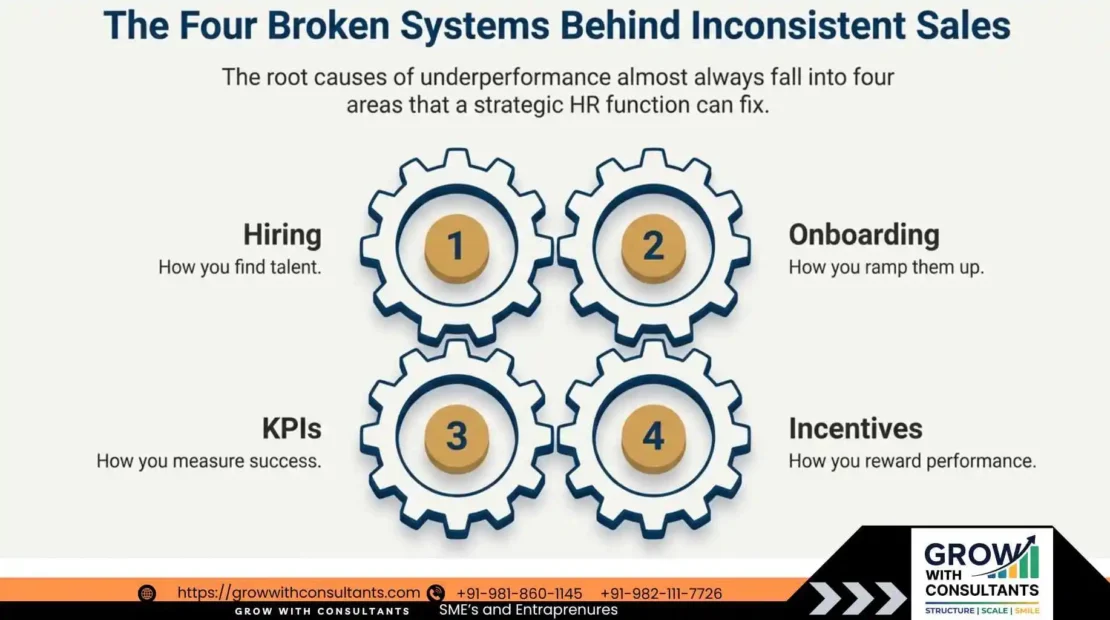
The Thing Founders Miss About Poor Sales
In most SMEs, when targets are missed, the first reactions are "the market is slow," "competition has dropped prices," or "marketing is not giving good leads." Very rarely does the founder say: our people systems behind sales are broken.
HR, when used strategically, can directly improve sales performance by redesigning how you hire, train, measure, and reward the sales team. The shift is from blaming individuals to fixing the infrastructure those individuals operate within.
Simple truth: If your system is weak, you will keep blaming individuals. Fix the system, and performance becomes predictable. The four root causes below are HR problems disguised as sales problems, and every single one has a structural fix.
4 Real Reasons Behind Poor Sales Performance in SMEs
Wrong Sales Hiring
Many SMEs hire "good talkers" or people with big-brand logos on their CVs. That does not mean they can sell your specific product to your specific customer at your price band, which is the only thing that matters.
The three most common hiring misfits:
- Buyer type mismatch: Enterprise sellers placed in SME or retail sales contexts, completely different skills, conversations, and timelines.
- Sales motion mismatch: Transactional salespeople placed in consultative sales roles that require building trust over multiple conversations before any close.
- Ticket size mismatch: Someone used to ₹5 lakh deals placed in a ₹50,000 average ticket environment, or vice versa. The psychology, patience, and process are entirely different.
Weak Onboarding and Training
Most SMEs give new sales hires a few days of product training and expect them to "figure it out." That produces two predictable outcomes: long ramp-up times (6–9 months instead of 2–3) and permanently uneven performance across the team.
What a proper HR-led sales onboarding plan actually covers:
- Defined sales process: Lead handling → qualification → discovery → demo → proposal → negotiation → closing → handover. Every step documented, not assumed.
- Objection handling: Scripts, practice, and feedback, not just "you'll figure it out in the field."
- CRM discipline: How to log activities, update pipeline stages, and flag stuck deals, built as a habit from Day 1, not retrofitted later.
No Clear KPIs or Performance Dashboards
In many SMEs, the only number that matters is "monthly revenue target." That is not a performance management system. It is a results scorecard. You cannot manage a sales team on a single lagging indicator because by the time the number is bad, the problem is 30–60 days old.
HR can help build a performance framework around both leading indicators (predictors of future results) and lagging indicators (results already achieved):
Misaligned Incentives and Recognition
If your incentive structure is unclear, delayed, or linked to the wrong behaviours, you will not get consistent performance. Incentive design is one of HR's highest-impact moves in a sales team, and one of the most commonly neglected.
Most SME incentive failures fall into these patterns:
- Only rewarding total revenue, ignoring activity metrics, deal quality, and collection discipline
- Incentive payouts delayed by weeks or months, destroying the motivation-behaviour link
- No non-monetary recognition, public acknowledgment of wins is equally powerful and costs nothing
- Targets set without consultation, leading to the team dismissing them as unrealistic from day one
Sales KPIs Every SME Should Track: Leading and Lagging
| KPI | Type | What It Tells You | Review Frequency |
|---|---|---|---|
| Leads contacted | Leading | Is activity volume sufficient to build a pipeline? | Daily / Weekly |
| First meetings booked | Leading | Is the team converting enquiries into qualified conversations? | Weekly |
| Qualified opportunities | Leading | Is the pipeline being built with real prospects, not wish list? | Weekly |
| Proposals sent | Leading | Are deals progressing through the funnel systematically? | Weekly |
| Win rate | Lagging | Is the team closing at a healthy percentage of proposals? | Monthly |
| Average deal size | Lagging | Is the team selling at the right ticket size or discounting? | Monthly |
| Revenue per salesperson | Lagging | Who is your top performer and what does the distribution look like? | Monthly |
| DSO (collection days) | Lagging | Is the sales team selling deals with healthy payment terms? | Monthly |
Find Out Which People System Is Breaking Your Sales
We'll audit your sales hiring process, onboarding structure, KPI framework, and incentive design, and identify exactly which gap is costing you the most revenue. Free 30-min call with Ameet.
What HR Should Actually Do for the Sales Team
For SMEs, HR's job is not just to process offers and manage payroll. HR must co-own sales performance levers with the Sales Headwhich means being involved in hiring profiles, onboarding plans, KPI frameworks, and incentive design. Not quarterly. Continuously.
- Define ideal salesperson profile per product and segment, before posting any job
- Use structured interviews, role-specific tests, and live role-plays to filter candidates
- Maintain a warm talent pipeline so hiring is not panic-driven when someone leaves
- 30–90 day onboarding with clear weekly milestones. Not "here's the product, go sell"
- Joint training calendar: product, market, competition, pitch, and objection handling
- Track time-to-first-deal as the primary onboarding success metric
- Standardise KPIs and dashboards across all salespeople, no individual exceptions
- Run weekly reviews based on data, not feelings or impressions
- Use insights to decide who needs coaching, a role change, or performance improvement
- Sales is high-pressure work. Burnout kills performance and accelerates attrition simultaneously
- Set realistic quotas and monitor workload regularly with sales leadership
- Train managers to give constructive feedback consistently. Not only apply pressure at month-end
The 30–90 Day Sales Onboarding Plan
Most SMEs onboard a salesperson in 2–3 days and expect full productivity within a week. Industry data shows the average ramp-up time for a B2B salesperson is 3–6 months, which is compressed to 6–8 weeks when a structured onboarding plan is in place.
Incentive Design: What Works and What Destroys Performance
- Simple, transparent structure, understood without a spreadsheet
- Tied to specific KPIs, not only total revenue
- On-time payouts. Every time, without exception
- Leaderboards visible to the whole team
- Public spotlight in weekly reviews for wins
- Quarterly bonuses tied to consistent performance, not just one big month
- Targets set collaboratively, team is consulted, not just informed
- Complex slabs that require a calculator to understand
- Revenue-only incentives that ignore pipeline quality
- Delayed payouts. Even 2-week delays break motivation
- Moving the target mid-period without explanation
- No recognition beyond salary. People need to feel seen
- Targets set in isolation by management with no input from the team
- Only acknowledging top performers, which ignores 60% of the team
Who Owns What: HR vs Sales Leadership
- Sales role profiles and structured hiring process
- 30–90 day onboarding plan and training calendar
- KPI framework design and dashboard setup
- Incentive structure design and payout process
- Performance management and improvement planning
- Engagement monitoring and burnout prevention
- Attrition tracking and exit interview insights
- Daily activity coaching and deal guidance
- Weekly pipeline reviews and deal progression
- Revenue target ownership and forecasting
- Market and competitive intelligence
- Customer relationship management
- Escalations and key account decisions
- Monthly performance conversations with each rep
The co-ownership model: HR fixes the infrastructure. Sales drives the activity. When both functions work on their respective responsibilities without crossing wires, and meet quarterly to align hiring, training, and incentives with the sales plan, performance becomes predictable rather than personality-dependent.
What SMEs Can Expect When HR and Sales Work Together
If your sales team is busy but not truly effective, don't start with another marketing campaign. Start with a hard look at your people systems. That is where HR can turn poor sales performance into a predictable growth engine. Ameet Mukherji, Grow With Consultants
Want to Make Your Sales Performance Predictable?
We'll help you build the people systems behind sales, hiring profiles, structured onboarding, KPI dashboards, and incentive design. Download the HR checklist or book a free call.


Frequently Asked Questions
How can HR help improve sales performance in SMEs? +
What are the main HR reasons sales teams underperform in SMEs? +
What HR metrics should link to sales performance? +
How does employee engagement affect sales results? +
Is HR responsible for sales targets? +
When should an SME formally involve HR in sales strategy? +
What is a good onboarding plan for a new salesperson? +
How should SMEs design sales incentives? +
What KPIs should SMEs track for their sales team beyond monthly targets? +
What results can SMEs expect when HR and Sales work together? +
Sources & References
- People Alliance: Why HR Holds the Key to Sales Performance
- Recruitee: The Role of HR in Driving Sales Success
- Forbes: Unite Sales Performance Management with HR
- Gallup: Employee Engagement Drives Growth
- McKinsey: Next-Level Sales Talent (HR's Message to the CEO)
- IHRIM: HR and Sales Performance Tracking
- HR Dive: HR's Role in Sales Quota Management
- Visier: Improve Sales Performance with People Data
Related Reading
Stop Blaming the Market.
Fix the People System Behind Sales.
Inconsistent sales is almost always a hiring, onboarding, KPI, or incentive problem. Not a market problem. Let's build the HR systems that make your sales performance predictable.