
Impact of HR on Business Performance: The Growth Lever Most Founders Ignore
HR sirf payroll aur attendance nahi hai. In most ₹5–₹100 Cr businesses, HR is still treated as admin, payroll, attendance, compliance. That's why execution breaks. Not because strategy is wrong, but because the people system is weak. So this guide explains exactly how HR drives the business metrics that matter.

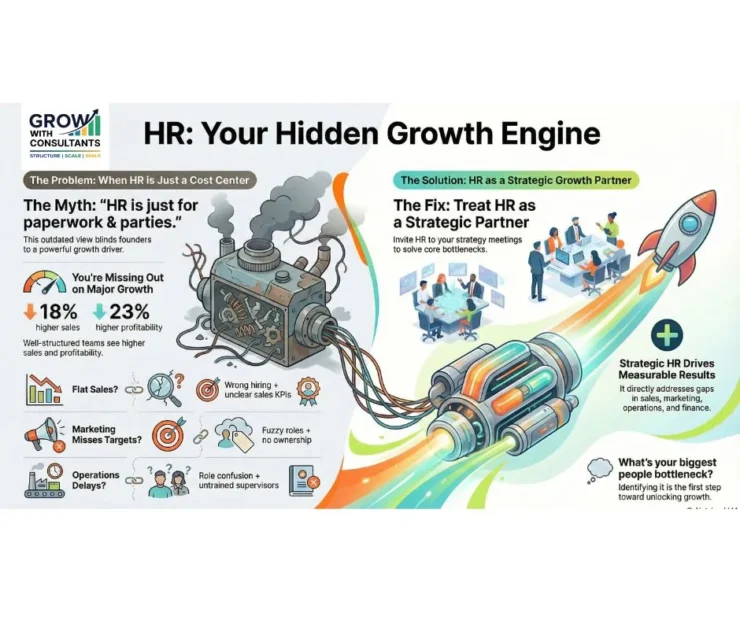
Why HR Is More Than Admin
Most founders experience HR at the surface level: offer letters, policies, employee records, and basic hiring. That layer is necessary. But it is not the growth lever.
When HR becomes strategic, it improves outcomes that show up directly in business numbers: productivity, quality, customer experience, and profitability. In fact, your people system decides whether your plan works or fails. Not market conditions. Not strategy. The people executing the strategy.
- Above all, most business problems are people-system problems in disguise
- Fix hiring + role clarity + KPIs + training + incentives
- So HR should sit in strategy meetings, not just admin reviews
- The link between HR and profitability is measurable, not theoretical
The Measurable Link to Business Results

Find Out Which People System Is Holding Your Business Back
30-minute session with Ameet. We'll identify the specific HR gap causing the most damage to your revenue or profitability, and give you a prioritised action plan.
Most Business Bottlenecks Are People Bottlenecks
Often, what looks like a sales, marketing, operations, or finance problem is usually a people-system problem. The issue shows up in one department, but the root cause sits in role design, capability, and accountability. So here is what that looks like across the four core business functions: For factories, see the manufacturing business growth audit.
Sales: Why Targets Are Missed
🔴 Visible Business Problem
Sales targets are missed. Forecasts are unreliable. Meanwhile, the team blames pricing, competition, or lead quality. Revenue is flat despite a full team and active marketing.
🟡 Hidden People-System Issue
Hiring profiles are vague. Training is ad hoc or product-only. KPIs stop at "monthly target." Incentives reward activity and effort, not outcomes and collections.
✅ HR Interventions That Fix It
- Define the ideal sales role: skills, mindset, deal ownership, and decision rights, before the next hire
- Instead, build structured onboarding and process-based sales training (not just product knowledge)
- Also track KPIs that matter: conversion rate, deal size, collections, and repeat sales, not just calls made
- Link incentives to outcomes (closed deals + collections) rather than effort (meetings attended)
Marketing: Activity Without Impact
🔴 Visible Business Problem
Campaigns run and content is created, but revenue impact stays unclear. Lead quality remains weak. The team is busy but the pipeline doesn't grow.
🟡 Hidden People-System Issue
Roles are fuzzy. No one owns lead quality or funnel outcomes. As a result, activity is tracked; contribution to revenue is not. Besides, sales and marketing work in silos with no shared accountability.
✅ HR Interventions That Fix It
- Redefine marketing roles with business-linked KRAs: qualified leads generated, CPL, pipeline value, not just posts published
- Create shared KPIs between marketing and sales with joint weekly reviews
- Then reward performance based on business outcomes (pipeline contribution), not vanity metrics (impressions, followers)
- Build accountability for lead quality, not just lead quantity
Operations: Founder in the Firefighting Loop
🔴 Visible Business Problem
Projects slip. Quality fluctuates. Rework grows. As a result, the founder gets pulled into daily operational firefighting and cannot step back from the business.
🟡 Hidden People-System Issue
Roles evolved informally as the business scaled. Supervisors were promoted without being trained to manage. Also, performance reviews focus on effort and attendance, not delivery and quality.
✅ HR Interventions That Fix It
- Clarify roles, responsibilities, and decision rights across the entire workflow, who owns what, who escalates what
- Set KRAs tied to delivery and quality: on-time delivery rate, rework %, rejection rate, SOP adherence
- Then train supervisors in planning, communication, problem-solving, and basic people management
- Build weekly review rhythm so issues surface in 24 hours, not in the monthly review
Finance: Cash Flow and Key-Person Risk
🔴 Visible Business Problem
Cash flow is tight despite decent revenue. Collections lag. Compliance is stressful. Critical financial knowledge sits with one or two people who can't be replaced.
🟡 Hidden People-System Issue
Roles overlap with no clear ownership. Meanwhile, finance performance is judged by firefighting ability, not by predictability and control. No cross-training, no backups for critical processes.
✅ HR Interventions That Fix It
- Separate clearly defined roles for billing, collections, compliance, and financial reporting
- Track clear KPIs: DSO (days sales outstanding), receivables ageing, invoicing error rate, on-time filing %
- Also build redundancy: critical processes must not be person-dependent; cross-train immediately
- Finally, tie finance team incentives to collections speed and accuracy, not just task completion
The HR Value Chain: How People Systems Create Business Outcomes
HR works like a value chain, not a checklist. When the chain is strong, execution becomes consistent. When it is weak, growth exposes cracks faster, and what felt manageable at ₹5 Cr becomes uncontrollable at ₹20 Cr.
Better Hiring → Stronger Capability
Clear Roles and KPIs → Fewer Delays and Less Rework
Training and Development → Fewer Mistakes → Better Service Quality
Performance Management and Rewards → Higher Engagement and Accountability
Most businesses don't fail because there are no ideas or no market. They fail because execution collapses. And execution collapses when people systems are missing. Ameet Mukherji, Grow With Consultants
The Right HR Metrics by Department
Still, most founders track revenue, costs, and cash flow. The people metrics that drive those numbers are rarely tracked, until a problem surfaces. So here is what to track monthly by function:
- Conversion rate (leads → closed)
- Average deal size
- Collection speed (days to collect)
- Repeat sales rate
- Pipeline value per rep
- Qualified leads generated
- Cost per qualified lead (CPL)
- Pipeline value contributed
- Lead-to-opportunity rate
- Channel-wise ROI
- On-time delivery rate
- Rework and rejection %
- SOP adherence rate
- Cycle time per unit/project
- Escalations to founder per week
- DSO (days sales outstanding)
- Receivables ageing profile
- Invoicing error rate
- On-time compliance filing %
- Cash runway visibility (weeks)
HR as Admin vs HR as a Strategic Growth Function
| Area | HR as Admin (Most SMEs) | HR as Strategic Function |
|---|---|---|
| Hiring | Reactive, when someone resigns | Proactive, role scorecard and hiring plan exist |
| KPIs | Attendance, headcount, salary processed | Conversion, productivity, quality, attrition |
| Training | Ad hoc or induction only | Skill-mapped, outcome-linked, tracked |
| Performance | Annual review or none | Quarterly KPI reviews + weekly check-ins |
| Incentives | Tied to effort and tenure | Tied to outcomes and business results |
| Strategy role | Not in strategy meetings | Present in revenue and growth planning |
| Founder involvement | Founder handles all people issues | Systems run, founder reviews metrics |
When Should Founders Involve HR in Strategy?
For ₹5–₹100 Cr businesses, HR must sit in strategy conversations, not just admin discussions. Specifically, involve HR when you:
The signal to watch: If your business is growing but execution is unstable, if quality is slipping, good people are leaving, or the founder is still in every daily decision. In fact, it is almost always a people-system issue hiding under "operations" or "sales." The strategy is probably sound. The execution infrastructure is not.
Founder Checklist: Start Here
If you want better business performance from your people system, start with these five questions. This takes one meeting per week and honest measurement, no expensive tools required.
Role Clarity
KPI Discipline
Manager Capability
Incentives Alignment
Hiring Accuracy
Diagnose Your People Bottlenecks: Free
If your business is growing but execution is unstable, a structured HR + performance review reveals what to fix first. Book a session with Ameet, or download the HR Bottleneck Evaluation tool.

Frequently Asked Questions
How does HR impact a business? +
How does HRM contribute to business success? +
What is the role of human resources in a business? +
How does HR add value to a business? +
Can HR really fix poor sales performance in SMEs? +
When should you hire your first HR head? +
Who should own HR in a ₹20–₹50 Cr company? +
What HR metrics should a founder track monthly? +
Is HR responsible for business performance? +
What is the HR value chain for business performance? +
Related Reading
Your Business Strategy Is Sound.
It's the People System That's Breaking Execution.
A structured HR + performance review reveals exactly which people system is causing the most damage, and what to fix first. Book a free session or download the HR Bottleneck PDF to start immediately.