
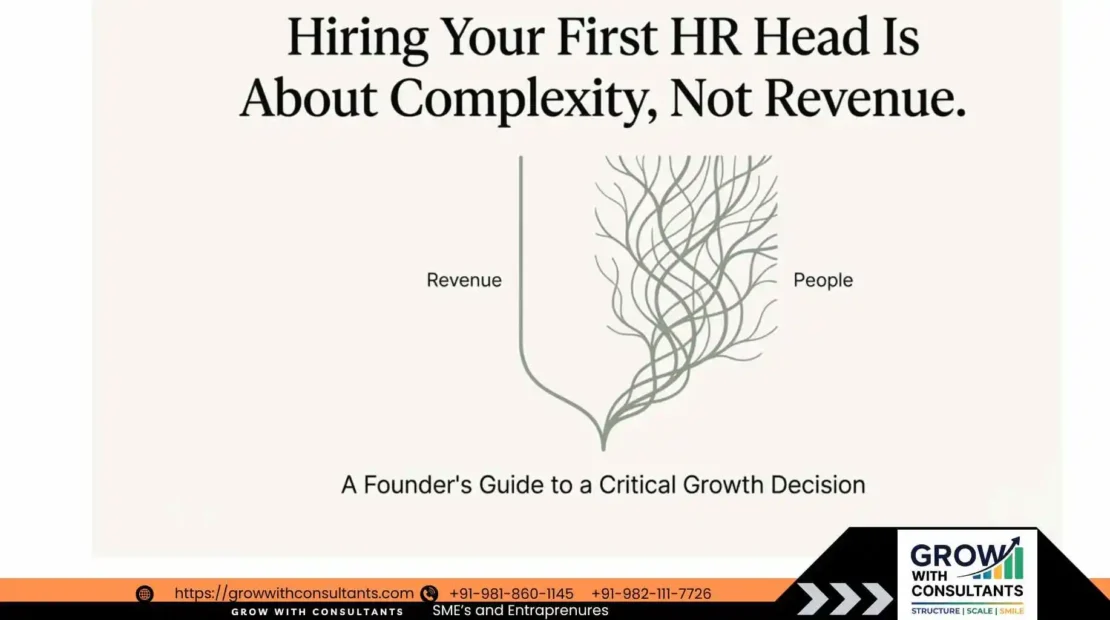
If any of these are true right now, you are already overdue
- You personally approve every salary, every hire, and every exit, and it is eating 20–30% of your week
- Three or more key employees have resigned in the last 6 months, and you still do not know why
- Your "HR" is a junior admin or an accountant doing payroll on the side, no performance systems exist
- Salaries in the same role vary wildly because they were negotiated ad hoc over the years
- New joinees take 2–3 months to become productive because there is no onboarding process at all
The single most common mistake I see Indian founders make, across manufacturing, services, and professional firms, is waiting too long to hire their first HR head. They treat HR as an expense that comes after growth. In reality, HR is what enables the next phase of growth.
By the time most founders realise they need a dedicated HR person, the damage is already done: high attrition, unclear roles, salary disputes, and a founder so deep in people problems that there is no bandwidth left to think about the business. The right HR systems for business growth start with hiring the right HR leader at the right time, not when you can afford one, but when people complexity starts blocking growth.
This guide gives you the exact triggers to watch for. It also tells you what your first HR head should actually do, and when a fractional approach makes more sense than a full-time hire.
The 5 Real Triggers, Not Revenue Milestones
Revenue is a lagging indicator. By the time you hit your target revenue, the people chaos is already baked in. Watch for these five operational triggers instead:
| # | Trigger | What It Looks Like | What It Costs You |
|---|---|---|---|
| 1 | Team Size & Hiring Velocity | 40–70 employees; 5–10 open roles at any time; founder or managers handling recruitment | Wrong hires, long vacancies, missed revenue targets |
| 2 | Founder Time Drain | 20–30% of leadership week goes into HR issues, salaries, conflicts, exits, appraisals | Zero strategic bandwidth; business stops growing |
| 3 | Performance System Absent | No written KRAs, no structured reviews, no clear promotion criteria. People guess what good looks like | High performers leave; low performers stay |
| 4 | Attrition Spike | Annual attrition above 20%; exit interviews not done; no data on why people leave | Constant rehiring costs, lost institutional knowledge |
| 5 | Compliance & Salary Chaos | Inconsistent salary bands, PF/ESI gaps, no leave policy, no documented HR policy | Legal exposure, resentment, salary disputes every quarter |
What Your First HR Head Should Actually Do (Not What Most Founders Expect)
Most founders hire their first HR head to "handle paperwork" and "manage attendance." That is the wrong brief. Here is what a properly deployed first HR head looks like in a ₹5–₹30 Cr Indian business:
-
1Build the Hiring and Onboarding Engine Standardise job descriptions, interview processes, assessment tools, and a 30/60/90-day onboarding plan for every key role. The goal: new hires reach full productivity 40–50% faster, and every hire is made against a written brief, not a gut feeling.
-
2Design the Performance and Accountability System Install KRAs and KPIs for every role. Create a review rhythm, monthly for managers, quarterly for all staff. Train line managers to give structured feedback. Connect performance to compensation bands so the link between contribution and reward is transparent and defensible.
-
3Bring Structure to Compensation and Policies Build salary bands based on market data, role complexity, and business stage. Write the core HR policy documents, leave, discipline, grievance, exit. This single step removes 70% of the salary disputes and "it's not fair" conversations that drain the founder every month.
-
4Build Culture and Engagement Intentionally Culture is not a poster on the wall. It is what gets rewarded and what gets tolerated. The HR head codifies the values into observable behaviours, builds feedback loops (engagement surveys, stay interviews), and creates the conditions for your best people to stay and grow.
-
5Become the CEO's People Data Partner Monthly HR metrics, attrition, time-to-fill, offer acceptance rate, performance distribution, should land on the CEO's desk the same day as the revenue report. The HR head is not an admin; they are a business partner who brings people intelligence to every strategic decision.
Why HR Leadership Is the Entry Point to the S.Y.S.T.E.M. Framework
The S.Y.S.T.E.M. Framework used across all Grow With Consultants engagements starts with people, because without the right people in the right roles with the right accountability, every other business system breaks down within 90 days.
Is Your Business Ready? The HR Hire Readiness Funnel
Based on 35+ years of working with Indian founders, here is how readiness for a first HR hire typically looks across businesses at different stages:
⚠ When NOT to Hire a Full-Time HR Head
If you are under 25–30 employees, hiring is sporadic, and needs are mostly operational compliance, a full-time HR head is premature. Start with a fractional HR consultant plus a junior HR coordinator. This gives you the systems without the full-time cost. Upgrade to a full-time hire when you cross 35–40 people or when hiring velocity exceeds 3–4 positions per quarter.
📋 The Fractional HR Path: Start Here if Unsure
Many of Ameet's clients use a fractional HR consultant for 6–9 months to install the core systems, hiring process, performance framework, compensation bands, basic HR policies, and then hire a full-time HR head to run those systems. This approach costs 60–70% less than a premature full-time hire and produces a much better outcome because the systems are in place before the person arrives.
✅ The Right Brief for Your First HR Head
Do not hire an HR head to manage attendance and process payroll. Hire them to build hiring systems, install performance accountability, create compensation structure, and reduce the founder's involvement in day-to-day people decisions from 70% to under 20% within 9 months. That is the brief that produces a return on the investment.
Not Sure If It's the Right Time to Hire an HR Head?
Ameet works directly with Indian founders to evaluate HR readiness and identify the fastest path to reducing founder dependency on people decisions, whether that is a fractional HR consultant, a full-time hire, or a structured interim model.
"The question is never 'Can we afford an HR head?' The right question is 'What is people chaos costing us right now, in founder time, in attrition, in missed revenue, in wrong hires?' When I run that number for a founder, the answer is always the same: the HR head pays for itself in 90 days." Ameet Mukherji, Business Growth Consultant, Gurgaon · 35+ Years · Forbes Recognised
Case Study: What Changed When the First HR Head Was Hired
A 38-person service business in NCR was at ₹12 Cr revenue with 34% annual attrition and a founder spending 25 hours a week on people issues. Here is the 12-month before/after after installing a dedicated HRBP as the first HR hire:
| Metric | Before HR Hire | 12 Months Later | Outcome |
|---|---|---|---|
| Annual Attrition | 34% | 12% | −22 points |
| Founder HR Time / Week | 25 hours | 5 hours | −80% |
| Time-to-Fill (avg) | 67 days | 31 days | −54% |
| Employees with Written KRAs | 0 | 100% | Full coverage |
| Salary Dispute Incidents / Qtr | 8–10 | 0–1 | −90% |
| Revenue Growth (YoY) | ₹12 Crore | ₹19.4 Crore | +62% |

As Featured In

Frequently Asked Questions: Hiring Your First HR Head
What is the right team size to hire the first HR head?
Typically 40–70 employees, depending on growth speed and complexity. But team size is not the only trigger. If you are at 30 people with 5–6 open roles at all times and the founder is losing 20+ hours a week to people issues, the hire is already overdue. Watch the triggers, not just the headcount.
Should I hire HR based on revenue or headcount?
Neither, primarily. Headcount, hiring volume, and people complexity matter far more than revenue. A ₹15 Cr business with 20 stable, long-tenure employees may not need an HR head yet. A ₹10 Cr business with 45 employees, 30% attrition, and 8 open roles needed one yesterday. The decision is driven by operational pain, not a revenue number.
Can I start with an external HR consultant instead of a full-time hire?
Yes, and for many businesses under 35 employees, this is the smarter path. A fractional HR consultant can install the core systems (hiring process, performance framework, compensation bands, HR policy) in 6–9 months at 60–70% of the full-time cost. Once the systems are in place, a full-time HR head runs them. This avoids the mistake of hiring a senior person into a structure-less environment.
What level should the first HR hire be, junior, mid, or senior?
For a 30–70 person business, hire a mid-level HRBP (5–8 years experience) who can both build systems and execute daily HR. A very junior person cannot build the infrastructure you need. A very senior Head of HR may be over-specced and under-utilised at this stage. The sweet spot is someone who has run HR for a 50–200 person organisation before, preferably in your industry or a similar one.
Who should the first HR Head report to?
Directly to the CEO or COO. Never to Finance or Admin. The reporting line is a power signal. It determines whether HR gets access to the information and the authority it needs to function as a business partner. If HR reports to Finance, it becomes a cost-control function. If it reports to Admin, it becomes paperwork management.
What should the first HR Head accomplish in 90 days?
By day 90, your HR head should have: completed an HR audit (salaries, policies, attrition data, open roles), written a 90-day action plan with the CEO, built or started a structured hiring process for the top 3 open roles, drafted a basic HR policy document, and created a draft KRA framework for at least one key department. If none of this has happened by day 90, the brief was wrong or the hire was wrong.
How does the S.Y.S.T.E.M. Framework connect to hiring an HR Head?
The S.Y.S.T.E.M. Framework, used in every Grow With Consultants engagement, starts with Staff Ownership (S) and Your People (Y). These two pillars cannot be built without an HR function that is operating as a business partner. The HR Head is the person who installs and maintains the people layer of the framework. Without that person in place, the other five pillars are built on an unstable foundation.
What are the warning signs that I hired the wrong first HR Head?
Three clear signs: (1) Six months in, the HR head is still primarily doing admin, attendance, payroll queries, letter drafting, and has not touched performance systems or compensation structure. (2) The HR head cannot explain the business model or the top three growth priorities. (3) Line managers see HR as a compliance department rather than a support function. Any one of these signals that the brief, the capability, or the reporting structure needs correction immediately.
Related Articles
Ready to Stop Doing HR Alone?
A free 30-minute call with Ameet identifies exactly where your people systems are breaking growth, and what your first 60 days of fixing it looks like.